
Measure. Treat. Verify: mobile and safe emission treatment
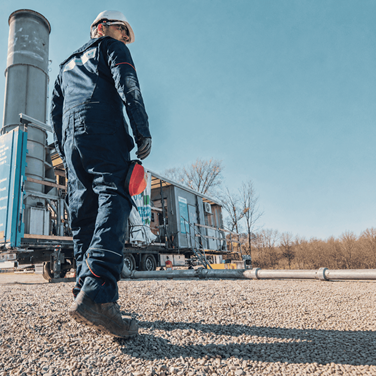
Whether during a tank inspection, prior to a vessel entering a shipyard, or while maintaining a stationary Vapor Recovery Unit (VRU): In many industrial processes, gases and vapors must be safely removed from facilities, tanks, and other vessels and treated under controlled conditions. This often presents challenges for operators of industrial facilities. Safety requirements must be met, emissions reduced, and downtime kept to a minimum. Mobile emission treatment offers a flexible solution.
Flexible solutions for industrial emissions
Mobile units can be deployed directly where emissions occur, for example at tank farms, refineries, chemical and petrochemical plants, as well as ports and loading terminals. Typical applications include the degassing of tanks and pipelines and the treatment of gases and vapors released during product changeovers, loading and unloading operations, turnarounds, inspections, and maintenance activities.
Another application is the temporary replacement of stationary emission control systems. For example, if a Vapor Recovery Unit fails or needs to be taken out of service for maintenance, mobile combustion units can temporarily take over emission treatment. This allows operations to continue under controlled conditions without prolonged interruptions.
Effective emission treatment involves more than simply combusting a gas stream. Safe process conditions, reliable measurement data, and transparent documentation of the results achieved are equally important. That is why we take a holistic approach to emission treatment, covering four interconnected service areas.
1. Mobile emission treatment
The first pillar is controlled emission treatment itself. Mobile combustion units can be used across a wide range of industrial applications and achieve a destruction efficiency of over 99.99%. Our mobile vapor combustion units (VCUs) safely and efficiently destroy gases, gas mixtures, and vapors of the explosion groups IIA, IIB, and IIC, without an open flame. Their key advantage is flexibility. The units are deployed on a project-specific basis wherever temporary emissions occur or existing stationary solutions are unavailable. This eliminates the need for operators to maintain additional permanent infrastructure.
2. Nitrogen & safety services
The safe handling of liquefied gases under pressure, such as LNG, ammonia, and propane, requires controlled and secure process conditions. The targeted use of nitrogen allows tanks, pipelines, and other components to be inerted and purged, preventing the formation of hazardous atmospheres. Mobile nitrogen vaporizers with atmospheric nitrogen storage tanks can be deployed flexibly and help to create a safe working environment. Nitrogen vaporizers can be used independently or in combination with a mobile combustion unit.
3. Emission measurement services
What needs to be treated? What concentrations are present? And how do conditions change throughout a project? Without reliable data, there is no sound basis for making informed decisions. That is why emission measurement forms another important pillar of our service portfolio. Measurements help establish a clear understanding of the initial conditions, monitor processes, and assess the effectiveness of the measures implemented.
4. Impact calculation & documentation
A project is far from complete once the technical emission treatment measures have been carried out. Companies must be able to demonstrate which emissions occurred, which measures were implemented, and what impact those measures had. This is relevant not only to internal environmental and sustainability objectives but also to the requirements of customers, regulatory authorities, and other stakeholders. Impact calculation & documentation provides a transparent and traceable basis for this. Project data, measurement results, and the effectiveness of the technologies applied can be consolidated and documented. In this way, an individual technical measure becomes part of a transparent and verifiable process.
Measure. Treat. Verify.
The four service areas work together, following a common approach.
Measure: First, the initial conditions and the emissions involved must be identified and understood.
Treat: Next, gases and vapors are treated using suitable mobile technologies while ensuring safe process conditions.
Verify: Finally, the results achieved are verified and documented.
“Measure. Treat. Verify.” therefore describes how individual services work together to provide a holistic approach to managing industrial emissions. For industrial facility operators, this means that mobile emission treatment is more than just a short-term technical solution. When properly planned, it combines flexibility, safety, emission reduction, and transparency – from the first measurement to the documented results.