
Nitrogen purging: safe handling of flammable gases

Flammable, explosive, and reactive substances play a critical role in many industrial processes. When products such as LNG, ammonia, propane, and butane are stored and transported, specific conditions must be met to ensure safe handling. Compared to many other products, these gases require special consideration in terms of handling, storage, and degassing, as they may be cryogenic, pressurized, flammable, toxic, or explosive, depending on the substance.
In the handling of such materials, nitrogen purging is of central importance. Tanks, pipelines, and other containments can be inerted with nitrogen to reduce the risk of explosive atmospheres and create the necessary conditions for subsequent degassing, maintenance, repair, or cleaning activities. Nitrogen purging is therefore a key component of industrial emission treatment.
What is nitrogen purging?
Nitrogen purging involves introducing nitrogen into tanks, pipelines, process equipment, and other industrial containments. As a chemically inert gas, nitrogen is ideally suited for creating a safe atmosphere within tanks and process systems. Purging, or inerting, is used to
- reduce the oxygen concentration inside the tank;
- prevent unwanted reactions such as oxidation;
- avoid the formation of explosive atmospheres;
- remove residual gases and vapors;
- prepare tanks for maintenance, repair, and cleaning work;
- enable safe product changeovers;
- prepare vessels and pipelines for shutdown periods.
Safety through controlled inerting
Many industrial applications involve processing, storing, and transporting substances that are highly flammable and therefore more complex to manage safely. Products such as LNG and ammonia pose increased risks, particularly in the presence of oxygen. Even small concentrations can form explosive mixtures under certain conditions. By introducing nitrogen in a controlled manner, the oxygen concentration within the system is reduced to a level where an explosive atmosphere can no longer form. The key parameter is the oxygen concentration limit specified for the respective substances and process. At the same time, residual gases and vapors can be displaced from the equipment. This creates the conditions required for safe inspections, maintenance and cleaning activities, as well as the shutdown and recommissioning of plant equipment and storage tanks.
In addition to its significant safety benefits, nitrogen purging also contributes to environmental and climate protection. Before work can be carried out on tanks, pipelines, or tank vessels – or before refilling operations begin – equipment must be brought into a defined safe condition and appropriately certified as safe. However, harmful residual gases often remain inside the tanks. If released uncontrolled, these emissions can endanger people and the environment, contribute to air pollution, and make compliance with environmental regulations more difficult.
Efficient mobile emission treatment with combustion chambers and nitrogen vaporizers
Mobile emission treatment systems provide highly efficient destruction of industrial gases and vapors and can be deployed flexibly wherever emissions occur. Mobile vapor combustion units thermally oxidize pollutants, off-gases, and residual gases with a destruction efficiency of over 99.99%, without an open flame. This enables the degassing of tanks, pipelines, and vessels while also temporarily compensating for outages of stationary emission treatment systems. As a result, gases, gas mixtures, and vapors can be treated effectively, significantly reducing their release into the atmosphere.
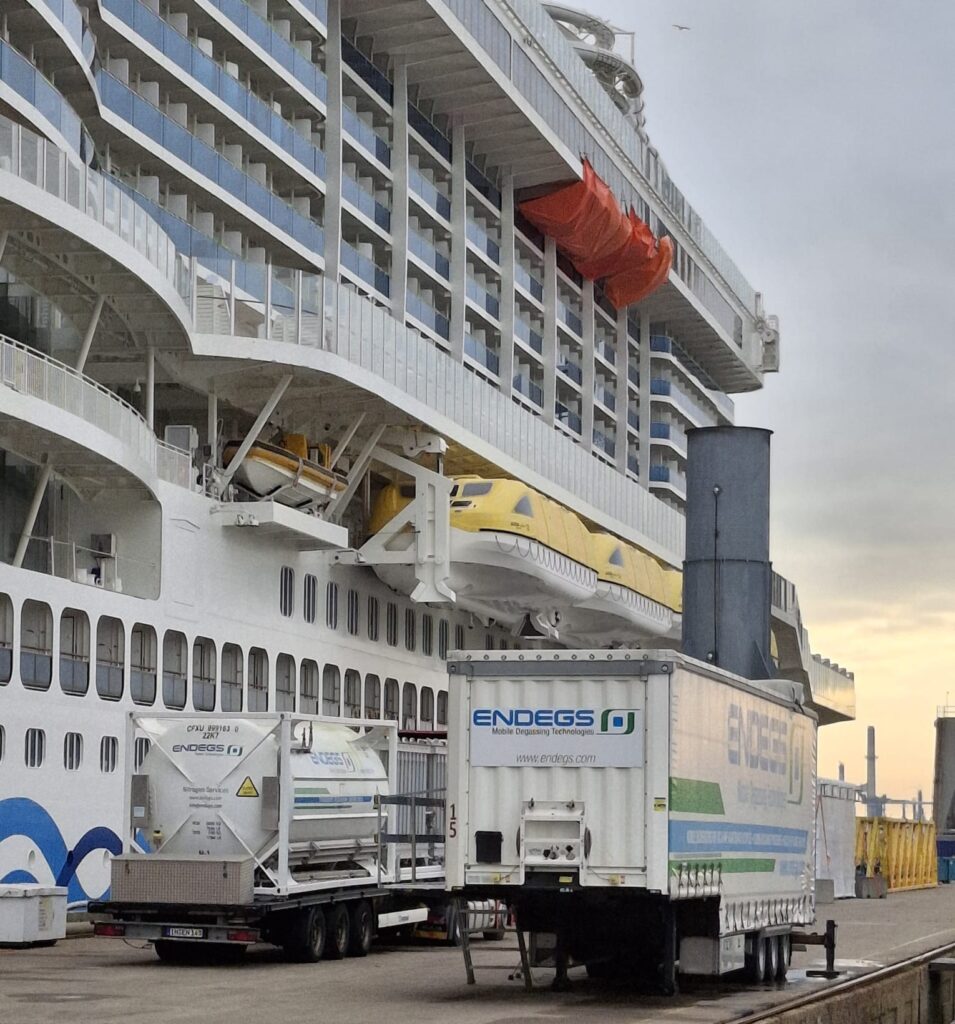
Mobile nitrogen vaporizers complement our emission treatment portfolio by providing inerting and purging capabilities. Their trailer-mounted design allows for flexible transportation and enables nitrogen purging directly at the site of operation. This is particularly advantageous in emergency situations and accident response scenarios, as well as during planned maintenance, repair work, and product changeovers. Our atmospheric vaporizers equipped with nitrogen storage tanks can be used at tank farms, refineries, ports and terminals, as well as locations without permanent infrastructure.


Project insights: applications of our mobile nitrogen vaporizer
Typical applications include product changeover purging, preparation for maintenance activities, purging of LNG tanks, and support during LNG cool down procedures. The ETS Degassing mobile nitrogen vaporizer can be used either as a standalone solution or in combination with a mobile vapor combustion unit for comprehensive degassing and purging operations.
Examples of projects where our nitrogen vaporizers have been deployed include:
- Purging of derailed rail tank cars: Following a train accident in Germany, four rail tank cars loaded with propane derailed. To eliminate the hazardous situation and safely empty the railcars, our mobile nitrogen vaporizer was deployed. The tanks were inerted, alloing the highly flammable gas to be safely directed from the tanks to the flare system. Once the tanks were emptied, recovery operations could begin.
- Cool down process for a cruise ship: A large cruise vessel in the Port of Rotterdam required an urgent cool down procedure. We received the request on a Friday evening, and by Saturday morning our operators had arrived on site with the mobile nitrogen vaporizer. The process began around midday and was completed during the night.
- Purging of an ammonia storage tank: For one of our customers, we carried out the purging and degassing of an ammonia-filled tank at an industrial facility.
- Purging and degassing of LNG fuel tanks: In the Netherlands, we performed the purging and degassing of LNG fuel tanks aboard a tanker vessel.
- Purging and degassing of an underground storage tank: For another project, we supplied a nitrogen vaporizer and a vapor combustion unit to purge and degas an underground tank containing butane.
- Decommissioning of an LNG tank station: In France, we supported the decommissioning of an LNG refueling station.
- Cool down of an LNG tanker: An LNG-loaded vessel in the Port of Amsterdam had to be degassed and rendered gas-free to enable repairs at a shipyard following storm damage. To support this operation, we supplied two mobile vapor combustion units. After the repairs were completed, we purged and degassed the vessel again to facilitate the cool down process prior to refilling the tanks with LNG.
Conclusion
Nitrogen purging is an essential component of emission treatment for safe and environmentally responsible industrial operations. As an inert gas, nitrogen reduces the risk of explosions and fires, displaces oxygen, and supports the controlled treatment of flammable, toxic, and reactive gases and gas mixtures. At the same time, the use of nitrogen requires strict safety measures, as oxygen displacement can create an asphyxiation hazard. When properly managed, nitrogen purging provides a safe, efficient, and environmentally sound method for preparing industrial systems for maintenance, shutdown, recommissioning, and product changeovers.
