
VOC emissions: why volatile organic compounds are so critical and how they can be reduced

Volatile organic compounds (VOCs) are a critical factor in many industrial processes. Whether in refineries, tank storage facilities, chemical and petrochemical plants, or intermodal freight transport, VOC emissions occur wherever organic substances are handled. They are harmful to both the environment and human health and should therefore not be released into the atmosphere untreated. But what exactly are volatile organic compounds, and how can they be effectively reduced?
What are volatile organic compounds?
VOCs are organic substances that transition into the gas phase through evaporation. The substances classified as volatile organic compounds evaporate even at relatively low temperatures, allowing these pollutants to enter the atmosphere in gaseous form. VOCs include substances such as benzene, toluene, xylene, solvents, and hydrocarbons originating from fuels or crude oil.
Volatile organic compounds are generated during industrial processes such as the production and storage of fuels and chemicals, the loading and unloading of tanks, maintenance and cleaning activities, as well as turnarounds and plant shutdowns. Particularly critical are residual gases that remain in tanks or pipelines after they have been emptied.
In addition to their impact on the environment, air quality, and human health, some VOC emissions can be harmful even at very low concentrations. Short-term exposure may cause symptoms such as headaches, dizziness, respiratory irritation, and nausea. The safe handling of volatile organic compounds is therefore an important component of occupational safety, health and environmental protection.
How VOC emissions can be reduced
Depending on the application, various treatment methods are available. Mobile vapor combustion units offer a particularly flexible solution and can be deployed independently of location for the treatment of volatile organic compounds. The resulting gases are thermally treated in a controlled process, achieving a VOC destruction efficiency of more than 99.99%. This enables volatile organic compounds and other emissions to be treated directly at their source – in refineries, tank farms, chemical plants, ports, loading facilities, and other industrial sites.
Tank degassing
A particularly important application is tank degassing. Before maintenance work, product changeovers, and inspections, tanks and other vessels often need to be cleared of residual gases. Without appropriate emission treatment, substantial quantities of VOC-containing gases would be released into the atmosphere in an uncontrolled manner.
Mobile vapor combustion chambers enable the degassing of tanks and the controlled treatment of these gases. Emissions are captured and thermally treated with an efficiency of over 99.99%. This significantly reduces volatile organic compounds before they can enter the atmosphere. In addition to all types of tanks – from individual storage tanks, spherical tanks, and underground tanks to road tankers and rail tank cars – pipelines, vacuum trucks, and process equipment that require temporary emission-safe treatment during maintenance activities can also be degassed.

Ship degassing
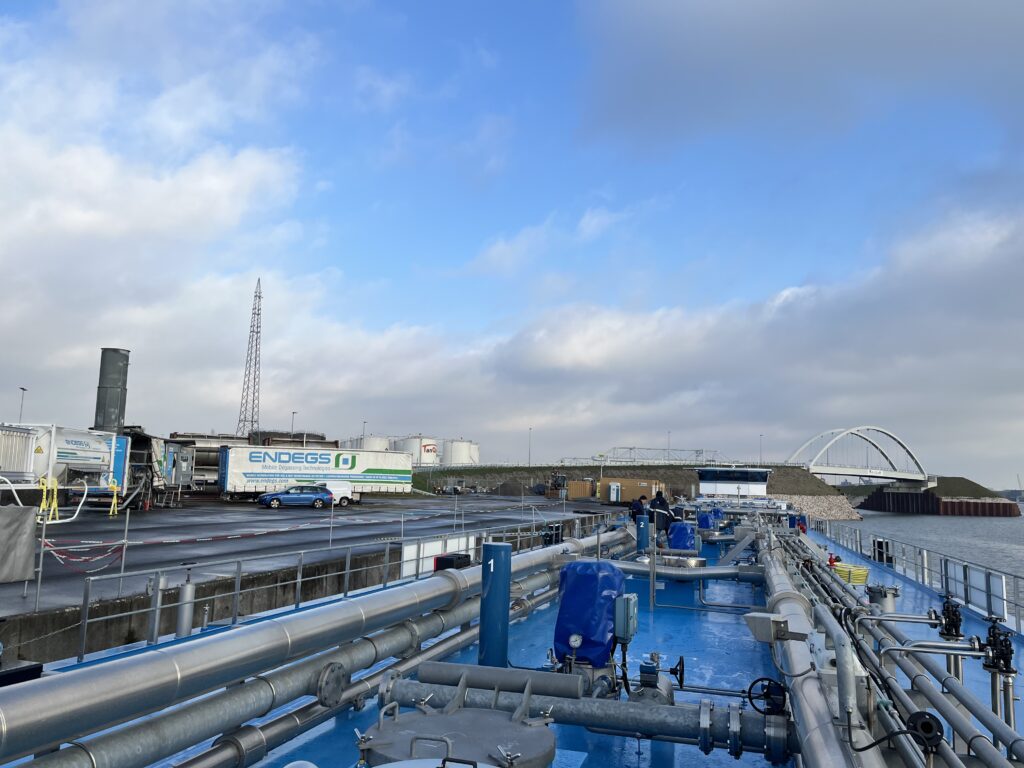
Controlled emission treatment is also a key factor in the maritime industry. Ships must safely and environmentally responsibly dispose of residual gases and must be completely gas-free before product changeovers, inspections, maintenance work, and repairs. Mobile vapor combustion units make it possible to treat residual gases and vapors from ship tanks in a flexible and low-emission manner. Their flexibility is particularly advantageous when no permanent infrastructure is available or when temporary solutions are required. These mobile systems, which can be transported as trailers or containers, can be deployed at short notice and within a short timeframe at ports, loading terminals, and docking facilities.
Temporary replacement solutions
When stationary emission treatment systems such as vapor recovery units (VRUs) require maintenance or experience unexpected failures, the treatment of generated emissions and compliance with emission limits must still be ensured. In such situations, mobile vapor combustion units can temporarily take over the role of a VRU and be rapidly deployed for emission treatment. This allows operations to continue without interruption during the downtime of stationary emission control systems while preventing uncontrolled VOC emissions. This flexibility is particularly important in tank farms, ports, and loading terminals, where tank trucks, rail tank cars, and tank vessels must be loaded and where entire supply chains and reliable product supply depend on uninterrupted plant operations.

Why VOC emission treatment matters
The requirements placed on companies to reduce VOC emissions continue to increase. Regulations such as the German Technical Instructions on Air Quality Control (TA Luft), along with other European environmental requirements, oblige operators of industrial facilities, tank storage terminals, and logistics hubs to minimize emissions. At the same time, pressure from sustainability and ESG requirements is growing. Companies must not only comply with legal emission limits but also demonstrate how emissions are being reduced. Mobile degassing and emission treatment systems provide a flexible, controlled, and auditable solution for the treatment of VOC-containing gases.
Conclusion
Volatile organic compounds are a key factor in sustainability, safety, and health protection across industrial operations. VOC emissions arise in numerous applications and are subject to strict regulatory requirements. Mobile systems enable controlled emission treatment and make a significant contribution to reducing VOC emissions.