
Why mobile degassing is essential during industrial transition phases

Operators of industrial facilities such as tank farms, refineries, chemical plants, or ports are facing increasing pressure. Environmental regulations are becoming stricter, safety requirements are rising, and at the same time there is an expectation to maintain operations with as little interruption as possible. Transitional phases are particularly challenging – periods when plants are not running under normal conditions. These include planned shutdowns, turnarounds, maintenance work, or product changes.
During these phases, residual gases and vapors continue to develop. They are harmful to both people and the environment and must not be released untreated into the atmosphere. For this reason, it is essential that residual gases and vapors are handled safely and in compliance with environmental regulations even during industrial transitional phases. This is exactly where mobile degassing and emission reduction come into play.
Flexibility instead of shutdowns
Many industrial plants rely solely on stationary emission treatment systems such as vapor recovery units (VRUs). But what happens when these systems themselves require maintenance or repair? Without alternative solutions, a complete plant shutdown may be unavoidable in the worst case.
However, this can be prevented. Mobile emission treatment systems provide a flexible and efficient alternative. They can be deployed on short notice and treat emissions directly at the source. This allows plant operations to continue even if a central infrastructure component like the VRU is temporarily unavailable.
A major advantage is that mobile systems can be installed quickly and are often ready for operation within a maximum of 24 hours. This helps to minimize downtime and prevent full plant shutdowns, allowing critical processes such as loading and unloading to continue.
Safety and compliance in focus
During industrial transition phases, the risk of uncontrolled emissions is particularly high. Tanks, pipelines, and process units often contain volatile organic compounds (VOCs) pr other hazardous substances. These chemical hazards must be safely removed before further work can be carried out. Mobile degassing and emission treatment systems enable exactly this, achieving efficiencies of over 99.99%, without an open flame.
This allows maintenance and inspection work to proceed as planned while ensuring documented and auditable emission management. By integrating mobile emission treatment into transitional phases, operators can improve planning reliability and reduce downtime. At the same time, compliance with legal requirements can be ensured without jeopardizing schedules or budgets.
Why planning reliability matters for complex projects
Turnarounds and maintenance are highly complex processes with tight schedules and numerous dependencies. Delays can quickly lead to significant costs. By integrating mobile emission control into project planning, risks can be significantly reduced. Facilities can be made gas-free more quickly, allowing maintenance work to begin earlier and keeping workflows predictable. The result: greater efficiency, lower costs, and improved planning reliability.
Proven added value in practice
With over 3,000 successfully completed projects, we have extensive experience in industrial transition phases.
For example, at a tank terminal in the Netherlands, we deployed one of our mobile vapor combustion units as a temporary replacement for a failed VRU. This allowed truck loading operations to continue without requiring a full plant shutdown.
In a long-term project in Rotterdam, our systems are in use at both a tank terminal and a refinery. At the terminal, our mobile thermal oxidizers treat emissions during the loading and unloading of ships and tank trucks and are in continuous operation. At the refinery, the system ensures that all emissions during ship loading are properly treated.
At a refinery in Germany, our systems were used during a long-term turnaround. Our team fully degassed several columns, heat exchangers, and liquid tanks. The deployment of our equipment lasted two and a half months in total. In a chemical plant in Finland, our mobile thermal oxidizer was used during a turnaround to degas several tanks simultaneously.
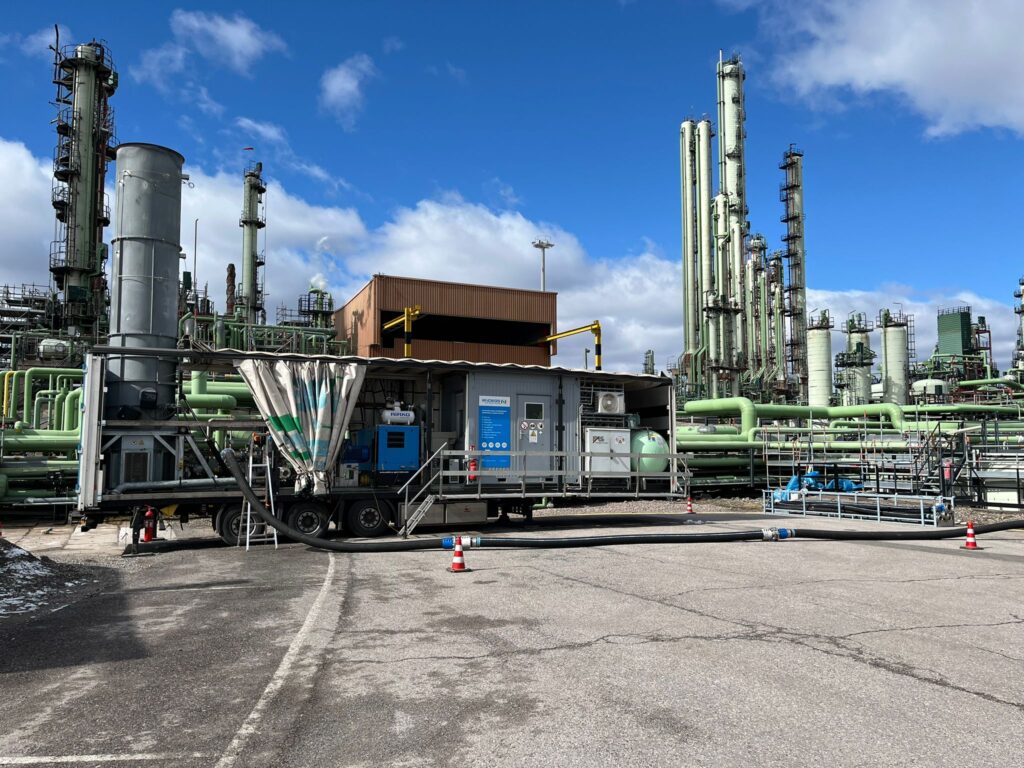
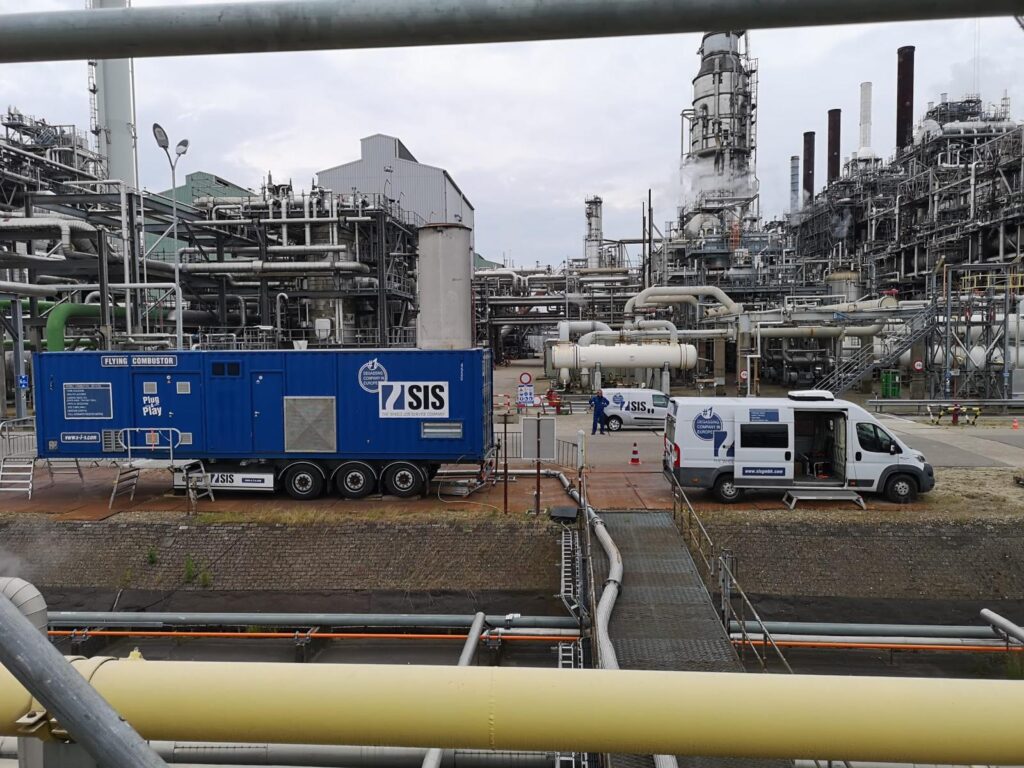
Transition phases such as turnarounds, shutdowns, or product changes are unavoidable in ndustrial processes. However, mobile degassing and emission treatment help to minimize their risks and operational impact. By using mobile vapor combustion units, emissions can be safely treated even when stationary systems fail. At the same time, operations can be maintained, and facilities can respond flexibly to changing conditions.
Learn more about our technologies and applications for mobile degassing and emission treatment.