
Intermodal transport without downtime: mobile degassing and emission treatment in freight transport

Ensuring safety and sustainability in logistics
In intermodal freight transport, safe and uninterrupted operations are essential. As soon as emission treatment systems are unavailable, operators quickly face a conflict between operational continuity, safety requirements, and environmental regulations. It is precisely at this interface that the importance of reliable solutions for the controlled treatment of residual gases and vapors becomes evident.
Challenges in intermodal transport
In complex supply chains, different modes of transport are connected: tank trucks, rail tank wagons, and tank ships transport large quantities of fuels, chemicals, solvents, and liquefied gases every day. During loading and unloading or product changes, emissions and vapors are generated that must be treated. Additionally, significant amounts of residual gases often remain in tanks, pipelines, or other containments. They must not be released uncontrolled into the atmosphere. Before maintenance work, inspections, repairs, or product changes, these remaining emissions must therefore be removed in a controlled manner.
In our work with various companies in freight transport, we have repeatedly experienced that processes cannot continue if stationary emission treatment systems fail. That is why we support intermodal transport with mobile technologies for degassing and emission reduction. These flexible solutions make it possible to maintain operations even under such conditions.
Flexible services for emission treatment in freight transport
Mobile emission treatment units can be deployed at short notice and flexibly provided at terminals, ports, logistics centers, or loading facilities. Pollutants are extracted from containers via piping systems and led into a mobile vapor combustion chamber. There, the vapors are thermally destroyed with an efficiency of over 99.99% and in an environmentally-friendly way without an open flame. The mobile vapor combustion units can safely treat gases, gas mixtures, and vapors of explosion groups IIA, IIB, and IIC, and meet strict environmental and safety standards.
Typical applications in intermodal transport include the degassing of tanks, for example in tank trucks, rail tank wagons, or tank ships, as well as pipelines and other containments. Mobile vapor combustion chambers can also serve as temporary replacement for stationary systems such as vapor recovery units (VRUs), for example during maintenance or in the event of unplanned outages. This allows downtime of stationary emission treatment systems to be bridged without stopping operations, thereby avoiding costly shutdowns.
Project insights: mobile degassing and emission treatment in freight transport
With more than 3,000 successful projects across Europe, we have supported numerous applications in the intermodal sector.
In road freight transport, for example, we temporarily replaced a stationary VRU in a refinery, allowing tank truck loading operations to continue. Around 340 tank trucks were loaded there daily. By deploying our mobile vapor combustion unit over a period of three months, we prevented a shutdown of the loading facility, enabling all refinery processes to continue without restriction. Another client commissioned us to degas ten LPG tank trucks for scheduled maintenance. In addition to a mobile vapor combustion unit, we provided further equipment such as pipelines, flame arresters, valves, pressure regulators, and T-pieces.
At a rail car terminal, we replaced the stationary VRU for six months. During this time, 22 rail tank cars per week continued to be loaded with ethanol. At another facility, we degassed several tail tank wagons that had previously been loaded with pressurized gases such as propane, propylene, propene, and isobutylene. This enabled inspection, maintenance, and repair work in the tank cars.
Emission treatment is also important for shipping as part of intermodal transport. In the Port of Amsterdam, for example, we degassed a damaged LNG tanker using two mobile vapor combustion units. The goal was to make the tanks completely gas-free so that maintenance and repair work could be carried out at the shipyard. After completion, we also used our mobile nitrogen vaporizer to perform a cool-down, allowing the vessel to be reloaded with LNG. At a terminal in Belgium, we used a mobile combustion chamber to handle emission treatment during ship loading when the stationary vapor recovery unit was out of service. This allowed loading operations to continue without interruption.


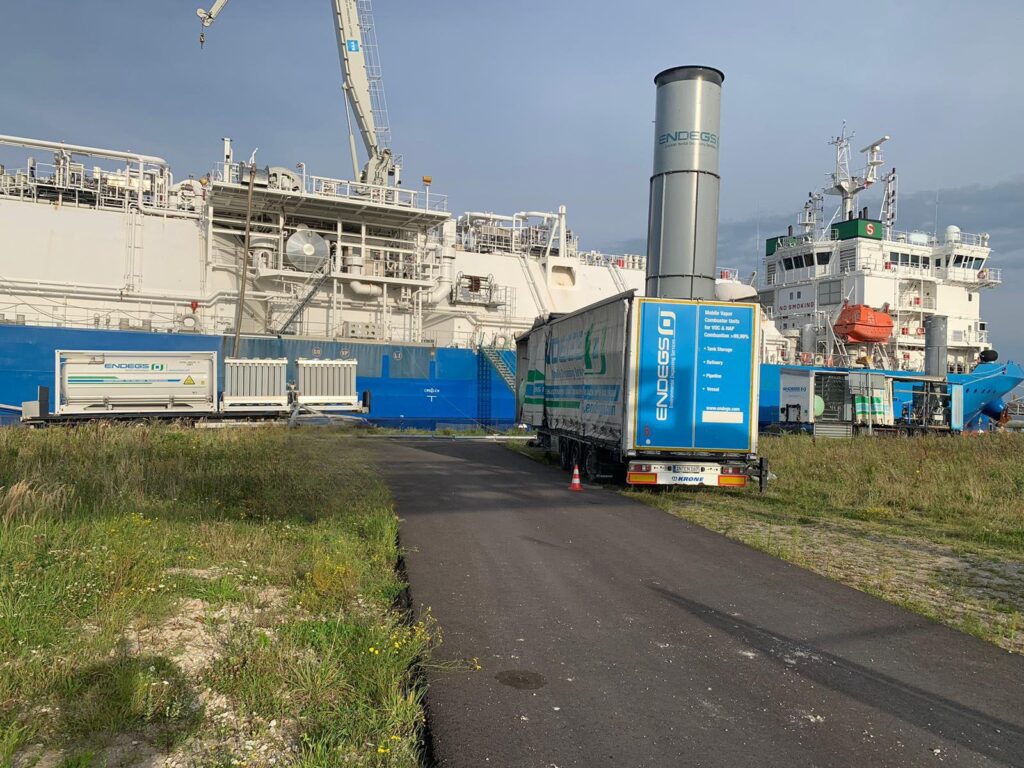
Intermodal transport requires operational safety and sustainability
Mobile degassing and emission reduction make a crucial contribution to reliable and sustainable intermodal transport. They ensure that residual gases are properly treated and that loading operations, maintenance, and repairs can continue even when stationary systems fail or are unavailable. The controlled on-site treatment of hazardous vapors and pollutants reduces downtime, minimizes safety risks, and helps to maintain environmental standards in freight transport. Mobile solutions for degassing and emission treatment are therefore an important component of modern logistics and ensure the continuous operation of intermodal supply chains.
Learn more about our technologies and applications for intermodal transport.